Teaching Tip: Why Quality Inspections Often Fail

We all know that students have trouble staying focused for a long lecture, even with the great job we all try to do. So try to find a short activity that will make a teaching point, break up the class for a few minutes, and get all the students enthused.  Here is something you may want to try in Chapter 6, Managing Quality. It takes about 10 minutes.

In this chapter, we have suggested that building quality into a process and its people is difficult. In the old days, inspection was the main form of quality control. But inspection may not catch all the errors, and it may be expensive. To indicate just how difficult inspections can be, ask your students to turn to the OM in Action box on page 234, called “Inspecting the Boeing 787”.

Ask them to each count the number of E’s (both cap and lower case), including those in the title. This should be a pretty easy inspection job, I think, and I offer a crisp $10 bill to the first student to give me the correct count. That usually gets their attention!

As they each finish, I ask them to shout out their count and I do a tally on the board. There is amazing variation and I only have to shell out the reward in maybe one out of five classes. The answer, by the way, is in the Instructor’s Solutions Manual, as discussion question #18.

If you can share a class exercise of your own, we would be very happy to publish it as a Guest Post.

Teaching Tip: Advice to Your Supply Chain Students


Prof. Darrell Edwards

Darrell Edwards, supply-chain professor at U. Tennessee and former COO of La-Z-Boy, shares professional wisdom for new graduates in Industry Week (Jan. 14, 2026). Darrell was also our guest on OM Podcast #37, speaking on the topic of global supply chain vulnerabilities.

  1. Build a Plan To efficiently increase your early career success, have a plan.  List your career goals for the first year and your objectives for assimilating successfully into your supply chain role.  A widely cited study on goal setting says, “you become 42% more likely to achieve your goals and dreams simply by writing them down on a daily basis.”  Regardless of your career objectives, put your goals on paper, set timelines for their achievement, and review and access them frequently.

2. Attitude Matters Most  Most companies will hire and promote aspiring leaders who collaborate well and are good team players with a “can-do” attitude.  Of course, you must possess basic managerial and leadership skills, but having a positive attitude goes a long way. Standout qualities could include always coming to work early or typically being the first to volunteer for a necessary but unglamorous project.  Companies promote attitudes.

3. Take a Line Job Don’t be afraid to take a job in a warehouse, a factory, or in a logistics hub; it will help accelerate your supply chain career. These skills are critical if you aspire to lead within a supply chain. It’s unlikely you will be able to land a significant corporate role in supply chain leadership without having also worked a line job.

4. Know the Business It’s OK if you don’t know all the specifics of the business when you start a role; as a new leader, you’re not expected to. That doesn’t give you a free pass not to learn it, and quickly.  Refine your skills in areas you understand but aggressively throw yourself into supply chain functions where you are weak.

5. Find a Mentor.  A mentor can help shorten the cultural learning curve and help you navigate the company “landmines.”  A mentor is in the unique position to offer advice on what to do—and most important, what not to do.  That person can help you develop the right questions to ask and advise you on your career plan.

6. Deliver Results Whatever the task, you must be prepared to deliver results and work to develop a reputation for doing so. Reputations are built early in a career, and once built, they are hard to change.


OM in the News: Biggest Supply Chain Threats for 2026

 IndustryWeek (Jan. 12, 2026) outlines four critical events poised to significantly impact the supply chain this year based on a research study by Evergreen Analytics:

  • Geopolitical fragmentation and the strategic use of trade regulations.
  • Extreme weather intensification.
  • Critical infrastructure aging and failure.
  • Cyberattacks on logistics.

Geopolitical fragmentation and the strategic use of trade regulations, ranked as the most notable risk for 2026 supply chains, giving it a “threat level” score of 97%. Abrupt geopolitical shifts have the potential to upend political alliances, alter trade relationships, create regional uncertainties and disrupt logistics networks.

In addition, rapid tariff and policy adjustments have become the new normal for supply chain management. From 2023 to 2025, export controls that caused severe disruptions doubled, and other trade restrictions increased 167%.

The next risk, extreme weather intensification, was given a “threat level” score of 93%. As the frequency and severity of these weather events continues to climb, firms are encouraged to  advance climate modeling for procurement, supply chain and logistics operations. They should also prioritize geographic diversification, increased inventory buffers and flexible logistics networks that can rapidly reroute around weather-impacted areas..

Third, critical infrastructure aging and failure, received a “threat level” score of 81%. Compromised infrastructure and transportation networks, combined with the previous risk of extreme weather, pose a real threat to supply chain operations. The Infrastructure Moment report by McKinsey & Company estimates that $106 trillion in investments, including $36 trillion for transport and logistics, will be needed to meet the need for updated infrastructure through 2040.

It is predicted that at least one multibillion dollar disruption because of failing infrastructure will occur this year. This implies that supply chain managers must develop comprehensive infrastructure risk assessments that go beyond their immediate suppliers to include the broader transportation and utility networks their operations depend on.

Lastly, cyberattacks on logistics sits at a “threat level” of 70%. Between 2021 and 2025, there was a 965% increase in attacks on logistics operations. It is  projected that cyberattacks on logistics operations will double this year. The five industries that experienced the most cyberattacks last year are: Manufacturing, Electronics,  Automotive,  Food & Beverage, and Logistics.

Classroom discussion questions:

  1. Compare these threats to supply chains to the ten discussed in Table 11.4 (page 474) in your Heizer/Render/Munson text. Which match?
  2.  Why do you think geopolitical issues is ranked first in this study?


Guest Post: From No Frills to Trendy Food, Fashion and Home, Walmart’s New Product Assortment 

Professor Misty Blessley, at Temple U., cohosts many of our podcasts, as well as sharing her insights with our readers monthly.

 Value retailer, Walmart, known for focusing on price-sensitive shoppers, has moved into premium products and broader brand assortments, with the goal of winning over customers with more buying power. Appealing to higher-income customers (those earning over $100,000), requires the firm to shift from a no-frills mindset. 

The firm remains committed to everyday-low-pricing (EDLP), thus it must continue managing this highly effective strategy while integrating broader lines. This requires a supply chain flexible enough to support both high-turn grocery and slower fashion and lifestyle products, for example. 

On the inbound supply chain side, Walmart diversifies its supply base to procure new products. As is outlined in Chapter 11 of your Heizer/Render/Munson book, this requires identifying, vetting and selecting new suppliers as well as a host of supply-side tasks like vendor and contract management. 

Managing inventory requires additional adaptations. Walmart refreshed the look of its website and stores while avoiding alienating its historical customers. It did so by keeping flagship items in stores and premium lines at distribution centers. Chapter 12 outlines inventory concerns Walmart faces, from the importance of inventory record accuracy to strategies for managing inventory. 

On the outbound side, the firm’s e-commerce and fulfillment operations must be capable of satisfying wealthier customers, who often expect faster, higher-service delivery options, such as same-day delivery or premium curbside pickup. Meeting these expectations puts pressure on Walmart’s fulfillment network for more micro-fulfillment centers and localized inventory pools to reduce delivery times. Facility, inventory, and transportation cost trade-offs are also covered in Chapter 11.

Walmart is an exemplar in omnichannel retailing because it seamlessly integrates its physical stores, online platforms, supply chain, and last-mile services into a unified customer experience. Its customers purchase and receive products when, where and how desired. Walmart is offering frills next to its no-frills strategy.

Classroom Discussion Questions:

  1. How would you call upon Ch. 11 and 12 as a Walmart supply chain manager? 
  2. Some firms target different customer segments under different brand names. For example, Gap Inc. owns Gap, Old Navy, Banana Republic and Athleta. Walmart has chosen a different strategy. How is Walmart capable of serving its price-sensitive and wealthier customers under one brand?

OM Podcast #44: Inside the Cold Storage Industry with Dr. Anna Johnson

Happy New Year!  In our first episode of 2026, Professors Barry Render and Misty Blessley sit down with Dr. Anna Johnson, Vice President of Marketing and Commercial Strategy at U.S. Cold Storage, to explore the fascinating world of temperature-controlled logistics.

Dr. Johnson explains how third-party logistics providers keep America’s food supply safe and efficient, why 98% of U.S. food storage is outsourced, and how sustainability initiatives like anaerobic digestion are reducing food waste.

Prof . Misty Blessley
Prof. Barry Render

The conversation also dives into industry trends—from the surge in capacity during COVID to the current state of the market—and highlights how AI, robotics, and digital twins are transforming operations, and creating new roles for skilled workers in this evolving sector.

Dr. Anna Johnson


Read the full transcript

Have you subscribed to this podcast on Apple Podcasts? Just open your Apple Podcasts app, search “Heizer Render Munson OM Podcast,” and subscribe to get all our episodes delivered straight to your device!

OM in the News: AI Is Mining Our Trash for Treasure

Here’s a job the computers can take without much complaint: sorting recyclables. For humans, it is a foul, laborious job that entails standing over a conveyor belt, plucking beer cans and detergent bottles from a stream of refuse. The job pays little and is hard to fill.

At one recycling facility near Hartford, machines are taking over the dirtiest jobs, reports The Wall Street Journal (Jan. 8, 2026). A few workers remain on the line, mostly to watch for hazardous items. Otherwise, the system of conveyors, magnets, optical sorters and pneumatic blocks runs largely unmanned. The technology allows them to sort up to 60 tons an hour of curbside recycling into precisely sorted bales of paper, plastic, aluminum cans and other materials. The material is sold to mills, manufacturers and remelt facilities, which pay more for cleaner bales.

AI is used to instantly spot recyclables and send instructions to machinery down the line at to remove them.

Watching over it all are computers that analyze material as it passes by at 7 mph. The devices use AI to identify recyclables, flag food-grade material, gauge items’ mass, assess market value and calculate points at which a robotic claw might best clasp each piece.

 The U.S. 50% aluminum tariff has lifted demand for scrap metal, while pulp mill closures have left box makers more reliant than ever on old corrugated containers. And consumer goods companies want to reclaim their bottles as states adopt extended producer responsibility laws aimed at reducing plastic pollution.

Part of the problem: Americans’ poor recycling habits are an obstacle to profit. A lot of beer cans and delivery boxes never even make it to sorting centers. A study in Virginia’s waste stream showed that 28% was recyclable, yet the system was stuck at a recycling rate of about 7% no matter how much it spent trying to teach people how and what to recycle.

The big breakthrough in recycling technology has been combining vision recognition systems with pneumatic blocks. Using puffs of air to separate items has proved much faster and more accurate than robotic pickers, which are limited to about 40 items a minute, compared with thousands for pneumatic system.

Classroom discussion questions:

  1.  Why has recycling been so inefficient?
  2. Should job loss through automation be a concern?

OM in the News: PepsiCo Turns To Digital Twins To Rethink Plants

We posted recently about the joint nuclear fusion digital twin work of Siemens and NVIDIA. Today’s news is that PepsiCo is working with the same two firms  to change how it designs, tests, and expands its plants and warehouses using AI and digital twins. “Physical industries are entering the age of AI. For companies with real-world assets, digital twins are the foundation of their AI journey,” said NVIDIA’s CEO.

By modeling factories and distribution centers digitally before making physical changes, PepsiCo hopes to cut down on costly mistakes while improving speed and capacity.

With AI-driven digital twins, teams can simulate plant layouts, equipment movement, and supply chain operations in detail, reports SupplyChain (Jan. 7, 2026). Instead of expanding facilities the old way, which can be slow and expensive, they can test changes virtually and see what works before spending money on physical upgrades.

“The scale and complexity of PepsiCo’s business is massive—and we are embedding AI throughout our operations to better meet the increasing demands of our consumers and customers,” said PepsiCo’s CEO. The digital models recreate machines, conveyors, pallet routes, and even worker movement, helping teams spot problems early and test different setups in weeks instead of months.

By finding bottlenecks and unused capacity in a virtual setting, teams increased throughput by 20%. The same approach has also shortened design cycles and helped cut capital spending by 10-15%. Testing ideas digitally first, teams can plan ahead, compare options, and move faster without the usual surprises that come with physical expansion.

Classroom discussion questions:

  1.  How is PepsiCo employing digital twins?
  2. How do AI and digital twins work together?

OM in the News: Digital Twins and Nuclear Fusion

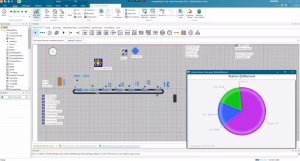
Digital twins, which we cover in Module F (Simulations and Digital Twins), is a big topic at Nvidia and Siemens as they work together to make nuclear fusion a commercial reality. In that chapter (see p. 847), we define a digital twin as:  “an electronic virtual replica of an operation that allows organizations to mimic how a product, process, or system will perform.”

Workers at Commonwealth Fusion Systems’ campus in Devens, Mass

Fusion engineers at the Nvidia/Siemens venture, called Commonwealth Fusion Systems (CFS), will use its digital twin to run simulations, ultimately to hasten the goal of producing fusion energy at a commercial scale. CFS “will be able to compress years of manual experimentation into weeks” with the AI assistance, said its CEO.

Nuclear fission, which splits atoms to produce energy, is already in use in power plants, reports The Wall Street Journal (Jan. 7, 2026).  But many companies see fusion, the energy process that powers the sun by joining atoms together, as a longer-term bet because it can provide much more energy in a cleaner process. Nuclear energy appeals to tech giants because it releases minimal carbon emissions while providing round-the-clock power—particularly as they look to fuel their AI ambitions.

CFS said it was working with Google on an AI project, and explained that that effort has created something like a co-pilot for its fusion machine, while the digital twin plan “is the virtual airplane.” Google also recently signed a power purchase agreement with CFS to secure energy from what could be the first grid-scale fusion plant.

“The race is on for AI. Everyone is trying to get to the next frontier,” said Nvidia’s CEO.

Classroom discussion questions:

  1. Provide other examples of how digital twins can be used.
  2. Why is this fusion project so important as an OM tool?

Our Top Five OM Podcasts of 2025

Our podcasts are gaining a wider and wider audience  and we are creating new ones every few weeks. In case you missed them, here are the top five of those that went live in 2025.

  1. OM Podcast #37:Global Supply Chain Vulnerabilities Professor Darrell Edwards at the U. of Tennessee shares his decades of industry experience.

  2. OM Podcast #34: An Inside Look at Tariffs  Bob O’Donnell, VP of Business Development of Life Sciences at East Coast Warehouse, who previously spent 13 years with Maersk, discusses tariffs and their potential impacts.

  3. OM Podcast #38: Editorial Leadership and the Future of  Operations Management Texas Christian University Prof. Tyson Browning  discuss Tyson’s six-year tenure as journal editor of the Journal of Operations Management, the evolving role of AI in research, and the future direction of the operations management field.

4. OM Podcast #32: Supply Chain Risk Management George Zsidisin, the Barringer Professor of Supply Chain Management at the University of Missouri – Saint Louis is author of several books on Supply Chain Risk.

5. OM Podcast #31: The Impact of AI on Jobs and the Environment  Charlie Render is President of Render Analytics, which helps businesses of all kinds implement AI.  He is also the creator of the popular job-search engine, Apply Genie (ApplyGenie.ai)

Have you subscribed to this podcast on Apple podcasts? Just go to your Apple podcasts app, search “Heizer Render Munson OM Podcast,” and subscribe to get all our podcasts on your mobile device as soon as they come out!

Our Top 10 Posts in 2025

Happy and Healthy New Years from our team of coauthors–Jay, Barry  and Chuck. As we close out 2025, we wanted to share the ten most highly read posts this year.

  1. The Supply Chain of the Future— a story of the “connector states” in Asia, led by Vietnam and Cambodia
  2. Top Five Global Supply Chain Risks–which include climate change, tariffs, cybercrime, rare minerals, and forced labor
  3. How China’s BYD is Squeezing Suppliers in the EV Price War–The Chinese automaker follows the word neijuan, which refers to a situation in which people work hard and compete fiercely without anyone getting ahead.
  4. Why Is It So Difficult for Robots to Make Your Nike Sneakers?— Nike has poured millions into an ambitious effort to partly automate what has always been a highly labor-intensive industry.
  5. The U.S. Made T-Shirt–Walmart has pledged to buy more items that were made, grown or assembled in the U.S.
  6. Supply Chains and Tariffs–Some manufacturers have reconfigured supply chains by reshoring portions of  production, by nearshoring—leveraging the USMCA free trade agreement (see Ch.2) to source more from Mexico and Canada—and by growing trade with countries such as India and Vietnam, which offer cost advantages.
  7. Holy Guacamole!–Few companies can match Chipotle Mexican Grill’s avocado appetite.
  8.  U.S. Energy Independence and Manufacturing–Over the past two decades the U.S. has evolved from a degree of foreign-energy dependency that threatened its economy and national security to the premier energy producer in the world.
  9. McDonald’s Gives Its Restaurants an AI Makeover–The fast-food giant’s new initiative uses artificial intelligence to target order accuracy and help restaurants detect equipment issues before they fail
  10. Starbucks Uses New Technology to Fill Orders Faster–Starbucks says new technology is helping fix one of its customers’ biggest gripes: waiting too long for their coffee

OM in the News: 3 Core Skills for the AI Manufacturing Workforce

 Companies invest heavily in workforce development—global corporate training represents over a $350 billion market—but few can answer the fundamental question: Does our workforce actually possess the capabilities required for AI-era manufacturing? The problem, writes IndustryWeek (Dec. 16, 2025), is that firms are training for yesterday’s skills while tomorrow’s requirements remain undefined.

Manufacturing faces a dual disruption. AI, robotics and automation are reshaping production at unprecedented speed, while skilled labor shortages intensify when experienced workers retire, taking decades of knowledge with them. Most training programs rarely assess whether workers developed the fundamental capabilities needed to work effectively in AI-augmented environments.

There are the 3 Core Skills needed:

1. Human+ capability This isn’t about workers learning to code or becoming data scientists. Human+ is the ability to work effectively alongside AI and automation—knowing when to trust algorithmic recommendations, when to override them based on judgment and how to optimize human-machine collaboration for maximum productivity. Manufacturers invest millions in AI-powered quality control systems, predictive maintenance platforms, and autonomous production scheduling—then struggle to achieve projected ROI because their workforce lacks the core skills to extract value from these technologies.

2. Agentic AI orchestration As AI-era manufacturing evolves from simple automation to autonomous agents that manage complex workflows, workers need the capability to orchestrate multiple AI systems effectively. Agentic AI orchestration is the ability to coordinate these systems so they don’t work at cross-purposes. It means understanding how to deploy AI agents for quality control, predictive maintenance, supply chain optimization and production scheduling—and managing the interactions between these systems when they conflict or produce unexpected results.

3. Interoperability catalysis Modern manufacturing runs on complex networks: older machines next to new robots, ERP systems talking to manufacturing systems, logistics platforms feeding production plans, and partner data coming in from suppliers. Interoperability catalysis is the ability to make all of that actually work together:

  • Legacy and modern systems (the 40-year-old CNC and the AI-powered vision system)
  • Digital and physical environments (ERP and planning data vs. shop-floor reality)

The Path Forward: Manufacturing’s competitive advantage in the AI era won’t come from having the most advanced technology. It will come from having a workforce capable of extracting maximum value from that technology. These 3 core skills represent the foundation. Manufacturers who systematically assess and develop these capabilities will thrive as AI reshapes production.

Classroom discussion questions:

  1. Is the current workforce capable of managing AI-manufacturing demands?
  2. Are business students interested and willing to take these jobs?

Guest Post: Drinking Graywater Beer?

Prof. Misty Blessley, at Temple U., raises an interesting sustainability issue.

Every drop of water on Earth is part of a continuous cycle. The same water brewed into beer eventually  travels through wastewater systems before being treated and returned to the environment, ready to be consumed again. Gray water is defined as: wastewater from showers, baths, bathroom sinks, and washing machines, excluding toilet water (blackwater) and water from kitchen sinks/dishwashers.

A San Francisco firm, Epic Cleantec, makes this cycle explicit by brewing beer with recycled graywater from showers and laundry. Buildings globally use 15% of all potable water, yet almost none reuse it. Partnering with nearby Devil’s Canyon Brewing Company, it created two beers—Shower Hour IPA and Laundry Club Kölsch, using water purified through a multi-stage system until it meets or exceeds potable water standards. Their approach demonstrates how scarce resources can be sourced in new and innovative ways.

Reusing waste water can help counteract climate change

The supply chain implications are significant. Brewing is water-intensive, requiring several gallons of water for every gallon of beer produced. As climate volatility and drought increasingly pressure municipal water supplies, integrating recycled water helps mitigate supply risk. Pairing this with drought-tolerant barley and hops further enhances supply chain resilience by mitigating upstream agricultural vulnerabilities.

Epic Cleantec’s model represents circular economy principles in action: closing loops, recapturing resources, and turning waste streams into valuable inputs. Many other food and beverage companies are embracing similar strategies. Rubies in the Rubble (UK) creates condiments from surplus produce that would otherwise be discarded. Upcycled Foods, Inc. (U.S.) produces SuperGrain flour to make bread from spent brewing grain. Planetarians (U.S.) transforms spent yeast and soybeans into a vegan meat product that is competitively priced compared to chicken and below beef.

Epic Cleantec emphasizes the circularity of its inputs to build consumer acceptance, hoping customers celebrate the closed loop. For details on the “circular economy” see Supp. 5 of your Heizer/Render/Munson text.

Classroom Discussion Questions:
1.  Forecasting is covered in Ch 4 of the Heizer/Render/Munson textbook. How would you forecast demand for beers made with recycled graywater, given potential consumer hesitation?
2.  TQM Tools are covered in Ch 6. Which tools should the two firms use to ensure water quality and process reliability throughout treatment and brewing?

Guest Post: Target Tests New Paths to Faster, Cheaper Delivery


Dr. Jon Jackson is Professor of Operations Management at Providence College. Jon has created AI classroom exercises for every chapter of our text. They are found in the on-line Instructor’s Resource Manual.

Target is experimenting with new fulfillment models as it tries to reverse a multi-year sales slump and better compete with Amazon and Walmart (The Wall Street Journal, Dec. 4, 2025). With online orders now making up nearly 20% of total sales, the retailer is searching for faster, cheaper ways to deliver packages while also improving in-store conditions for shoppers frustrated by clutter, stockouts, and long wait times. To do this, Target is piloting three distinct approaches in Chicago, Cleveland, and San Diego.

Chicago: Shifting Fulfillment Away from Busy Stores
In Chicago, Target stopped fulfilling next-day, ship-to-home orders from 18 of its busiest stores. Those orders are now handled in less busy locations. The result: delivery times sped up by about a day, shipping costs dropped to the lowest level among all Target markets, and stores became cleaner, better stocked, and less chaotic for in-person customers.

 Cleveland: A Dedicated Sortation Center
Cleveland is home to a new 40,000-square-foot sortation center operated by Ryder. Stores still pick and pack orders, but the sortation center batches them by neighborhood and hands them off exclusively to Shipt drivers. This frees store teams from the labor-intensive sorting process and enables more frequent pickups than national or regional carriers typically provide.

San Diego: In-Store Sorting for Local Delivery
In markets without a sortation center (e.g., San Diego), Target is testing a lighter-weight model. Stores sort brown-box deliveries in the backroom and hand them directly to Shipt drivers for local delivery. It’s a hybrid approach that allows next-day delivery without major new infrastructure.

Classroom Discussion Questions

  1. Which model seems most scalable for Target nationally, and which seems most context-specific?
  2. How might competitors respond if one of these approaches proves highly successful?

OM Podcast #43: An Interview with Mike Rich, VP of Supply Chain at American Water

In our latest podcast episode Barry and co-host Misty Blessly welcome Mike Rich, Vice President of Supply Chain at American Water, the largest regulated water and wastewater utility in the United States.

Mike Rich

Mike shares his fascinating career journey—from managing thousands of SKUs at Home Depot to driving strategic sourcing initiatives at Arizona Public Service—and how those experiences shaped his leadership approach today. The discussion dives into:

  • Building a customer-service mindset in supply chain
  • Challenges in talent acquisition and team growth
  • Negotiation strategies and risk mitigation in procurement
  • The role of AI and Agentic AI in transforming category strategy and operations


Read the full transcript

Have you subscribed to this podcast on Apple Podcasts? Just open your Apple Podcasts app, search “Heizer Render Munson OM Podcast,” and subscribe to get all our episodes delivered straight to your device!

Prof. Misty Blessley
Prof. Barry Render